
Tire Pressure Light Guide
Tire Pressure Light On? Start Here
A steady light, a flashing light, and a light that comes and goes each mean something different. This guide from Emergency Mobile Tire Repair tells you which one you have and what to check. It also tells you when the light means a leak worth a call.
- Steady light: at least one tire is below the pressure the system expects
- Flashes at startup, then stays on: the monitoring system itself has a fault
- On cold mornings, off by midday: pressure fell with the temperature
- Light plus a tire that looks low, a thump, or pulling: stop and call
What the light is
What Your Tire Pressure Light Is Telling You
TPMS stands for tire pressure monitoring system. It watches tire pressure while you drive and lights the dash symbol when something is off. The symbol looks like the cross section of a tire with a mark inside it.
On most cars the system is one of two kinds. Direct systems use a sensor inside each wheel that reports the pressure. Indirect systems use the ABS wheel speed sensors. A low tire turns more times per mile, and the system notices.
The light does not tell you which problem you have. A low tire, a cold morning, a dying sensor, and a slow leak all light the same symbol. The rest of this page helps you tell them apart.
If the light is on and the car also feels wrong, treat it as a flat. Pull over where it is safe, hazards on, and call us. Everything else can be checked in a driveway with a gauge.
Five minutes in the driveway
Check Your Pressure in Five Steps
- 01
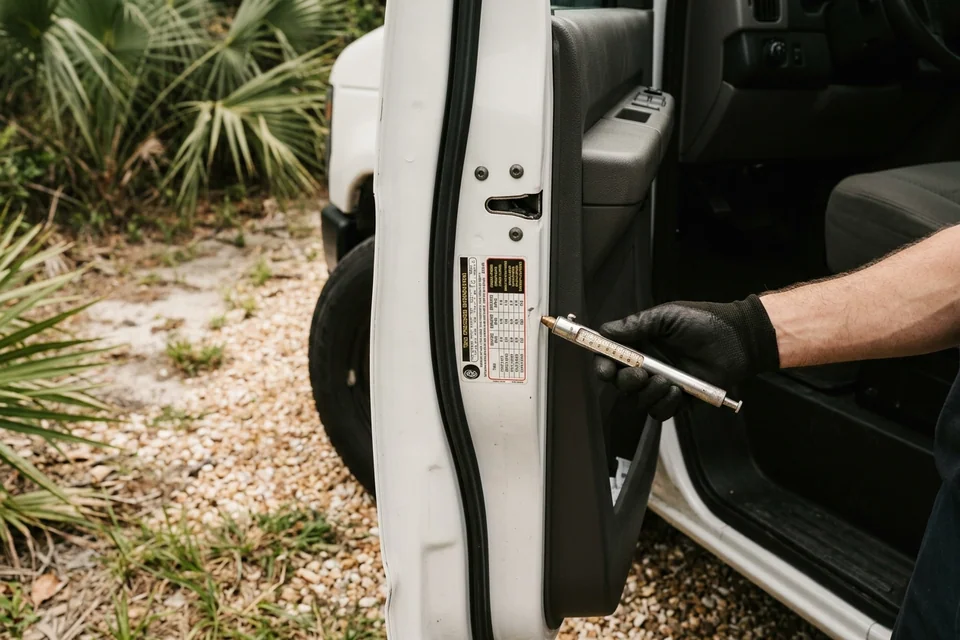
Find the placard
Open the driver's door and look at the jamb. The sticker lists the correct cold pressure for the front and rear tires. Use that number, not the one on the tire sidewall.
- 02
Check cold
Pressure rises as you drive. Check before the car has moved, or after it has sat for a few hours, so the reading matches the placard.
- 03
Use a gauge on all four
Unscrew each valve cap and press the gauge on straight. Write the readings down. Check the spare too, in case it has a sensor or you need it later.
- 04
Inflate to the placard
Add air at home or at a station until each tire matches its number. Do not fill to the max pressure printed on the sidewall. That is a limit, not a target.
- 05
Drive and watch
On most cars the light clears after a few minutes of driving. Some cars need a reset step from the owner's manual. If the light comes back within days, keep reading.
The three lights
What Each Light Means
A steady light
At least one tire is below the pressure the system expects. On most cars the trigger is a set amount under the placard, so the tire may not look low. The federal tire pressure monitoring rule (NHTSA) sets that amount. Check all four with a gauge, and the spare if it has a sensor.
Many newer cars show the pressure per tire on the dash. If one reads lower than the rest, that is the tire to watch. If all four are a little low, the weather or time since the last top-up is the likely cause.
A light that flashes, then stays on
A light that flashes for a minute or so at startup and then stays on is the system reporting a fault, not low pressure. Common causes: a sensor battery that has died, a sensor damaged during a tire change, or a new sensor the car has not learned yet.
Your tires may be fine. Check them with a gauge anyway, because a faulted system cannot warn you about a real leak. Sensor replacement and relearning is shop work on most cars. It is not a service we list. Ask on the call and we tell you honestly where to take it.
A light that comes on cold mornings and goes off later
Tire pressure falls as the temperature falls. A cool night can drop a tire enough to trip the light, and a few miles of driving warms it back above the line. This is common after the first cool nights of the year.
The fix is the same: set every tire to the placard pressure when cold. A tire set to the placard on a warm afternoon will read low the next cool morning, so check it cold. If the light returns every morning for a week, one tire is probably leaking.
When the light means a leak
A leak looks like this. The light comes back within days of a fill. One tire reads lower than the others every time. You hear a hiss or see a nail head in the tread. Then it is no longer a pressure question. Our slow leak page covers how we find it. Call and we come to the car.
When to stop driving
- The light is on and one tire visibly sags or looks flatter than the others
- You feel a thump, a wobble, or the car pulling to one side
- The light came on suddenly at speed along with a change in how the car drives
- The pressure readout shows a tire far below the others and still falling
In those cases pull over where it is safe, put your hazards on, and do not drive on it. Driving on a low tire can damage the sidewall from the inside and turn a repairable puncture into a replacement. Call Emergency Mobile Tire Repair and tell us what you see.
After a spare install
Compact spares usually carry no sensor. On most cars the light stays on, or shows a dash, until the full-size tire is back on the car. That is expected. Treat it as a reminder that the spare has its own speed and distance limits, printed on the spare, and plan the replacement soon.
What we do on site
We check and set pressure on all four tires, fix valve stem leaks, and find slow leaks at the car. A tread puncture within U.S. Tire Manufacturers Association repair limits is repaired on site. If not, we help with the spare or a replacement where available. Sensor replacement is not a listed service, so ask on the call.
Which light is it
Match the Light to the Action
Three behaviors, three different next steps. Find your column and read down.
| Criteria | Steady light | Flashes, then stays on | On cold, off later |
|---|---|---|---|
| What it usually means | One or more tires are below the pressure the system expects | A system fault: dead sensor battery, damaged sensor, or a sensor the car has not learned | Pressure fell with the overnight temperature and recovered as the tires warmed |
| What to do now | Check all four with a gauge when cold and inflate to the placard | Check pressure with a gauge anyway. The system cannot warn you while it is faulted | Set all four to the placard when cold and watch the next morning |
| Call us when | The light returns within days, or one tire keeps reading lower than the rest | Pressure is fine and you want to know where to take it. Ask on the call | The light returns every morning for a week, or one tire is the low one every time |
| Likely fix | Air, or a slow leak repair when a puncture is found | Sensor service or relearn, usually shop work | Air, and a leak check if one tire keeps dropping |
What it usually means
- Steady light
- One or more tires are below the pressure the system expects
- Flashes, then stays on
- A system fault: dead sensor battery, damaged sensor, or a sensor the car has not learned
- On cold, off later
- Pressure fell with the overnight temperature and recovered as the tires warmed
What to do now
- Steady light
- Check all four with a gauge when cold and inflate to the placard
- Flashes, then stays on
- Check pressure with a gauge anyway. The system cannot warn you while it is faulted
- On cold, off later
- Set all four to the placard when cold and watch the next morning
Call us when
- Steady light
- The light returns within days, or one tire keeps reading lower than the rest
- Flashes, then stays on
- Pressure is fine and you want to know where to take it. Ask on the call
- On cold, off later
- The light returns every morning for a week, or one tire is the low one every time
Likely fix
- Steady light
- Air, or a slow leak repair when a puncture is found
- Flashes, then stays on
- Sensor service or relearn, usually shop work
- On cold, off later
- Air, and a leak check if one tire keeps dropping
Repair availability depends on tire condition, damage location, tire size, and safety. If the tire cannot be safely repaired, we help with the next best option.
Pressure light questions
Tire Pressure Light Questions
Why does the light come on in the morning and go off later?
Tire pressure drops as the air cools overnight, and a cold tire can fall below the point that trips the light. A few miles of driving warms the air and the light clears. Set all four tires to the placard pressure when cold. If it keeps happening on one tire, that tire is probably leaking.
The light is flashing. What does that mean?
On most cars a light that flashes at startup and then stays on means the monitoring system has a fault. It does not mean a tire is low. A dead sensor battery or a sensor damaged during a tire change are common causes. Check your pressure with a gauge anyway, since the system cannot warn you until it is fixed.
Can you reset my TPMS light?
Often the light clears on its own once every tire is at the placard pressure and the car has been driven. If a leak caused it, fixing the leak and setting the pressure usually clears it. A sensor fault needs a sensor service or a shop. We do not list sensor replacement, so ask on the call and we tell you what we can do.
Steady light causes
Why a Steady Light Comes On
Five common reasons, from the harmless to the one that needs a visit.
Temperature drop
Cold air takes up less space. A cool night can pull every tire under the line at once. Air them up to the placard and the light should clear.
A slow leak
A nail, a screw, or a bad seal at the rim lets air out over days. One tire reads lower every time. We find it at the car.
Learn moreA leaking valve stem
The small rubber or metal stem can crack with age or leak at the core. A quick fix on site when that is the whole problem.
Learn moreAfter a tire change
A sensor can be damaged in the swap, or the car may not have learned a new one yet. The light may flash first, then stay on.
A spare with no sensor
Most compact spares have no sensor. After a spare install the light usually stays on until the full-size tire is back.
Learn more
Not sure which one you have? Call us. We talk through it on the phone before anyone rolls.
Worth five minutes
What a Quick Pressure Check Saves
A gauge and the placard answer most pressure lights at home. Here is what that buys you.
A tire you can still repair
A puncture found while the tire still holds air is usually a tread repair. One driven low for a week may have sidewall damage inside and need replacing.
Guesswork on the call
Four readings tell us whether this is weather, one leaking tire, or a sensor fault. That tells us whether a visit will help or a shop is the right stop.
Wear on the other three
Tires run low wear more at the edges and use more fuel. Setting all four to the placard is simple tire care, not just a way to clear a light.
A roadside stop later
A tire losing air in the driveway keeps losing it on the highway, where stopping is harder. Catching it at home beats catching it on I-4.
Keep reading
Related Pages
- All tire resourcesGuides, the glossary, and the cost and mobile versus shop pages in one place.
- Slow leak diagnosisHow we find where the air is going once you know a tire is leaking.
- Mobile tire repairWhat we repair at the car and when a repair is not the right call.
- Spare tire installationGetting the spare on and inflated, and why the light may stay on after.
- No spare tire? Your optionsInflator kits, run-flats, and mobile replacement when the trunk is empty.
- Tire and roadside glossaryTPMS, placard pressure, valve stem, and the other terms on this page.
- Check your service areaEnter a ZIP or city to see if we cover you.
- Contact and hoursPublished hours and every way to reach us.
Light On and One Tire Keeps Dropping?
Call Emergency Mobile Tire Repair at (352) 531-6319 and tell us what the dash shows. We tell you whether it sounds like air, a leak, or a sensor, and give you an honest ETA when a technician is available.
(352) 531-6319