
Trailer Tire Assistance
Trailer Tire Help, Where Available
Boat trailer, utility trailer, cargo trailer, or camper with a flat or blown tire. Call Emergency Mobile Tire Repair with the trailer type and tire size. We confirm on the call whether we can help where you sit. Trailer tire assistance is offered where available and depends on tire size and technician availability.
- Where available: we confirm on the call before anyone rolls
- Repair, spare install, or a replacement trailer tire, depending on damage, size, and availability
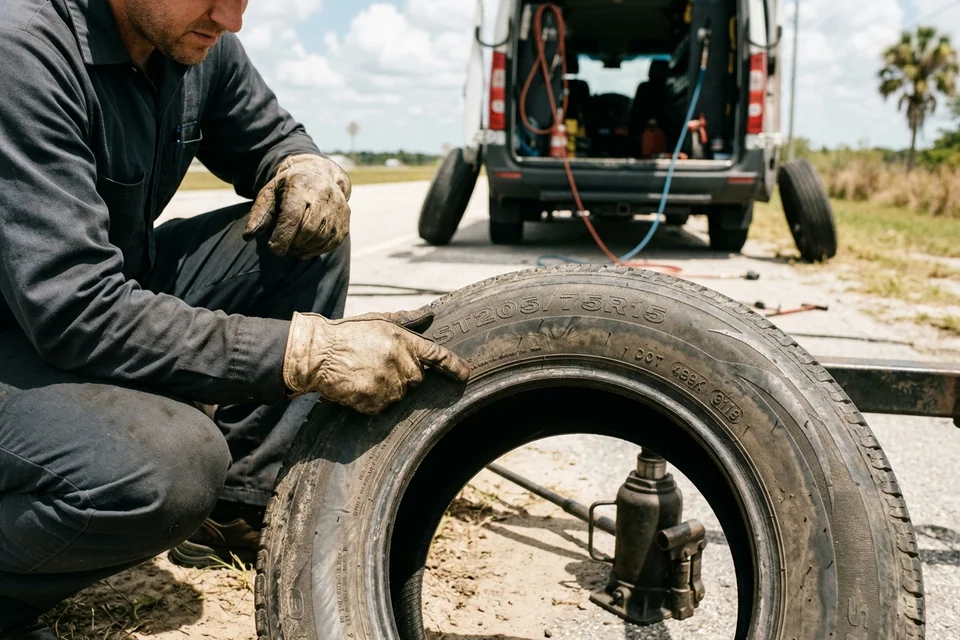
- No trailer spare? Send a photo of the sidewall. The size is printed there
- Loaded or tandem-axle trailers sometimes need a tow instead. We say so honestly
What this service is
What Trailer Tire Assistance Covers
Trailer tire assistance means a technician comes to the trailer where it sits and deals with the tire there. Where available, we can repair a tread puncture within repair limits, install the trailer's own spare, or mount a replacement trailer tire. We set pressure to the trailer placard before you pull away.
The condition matters, so we say it early. Whether we can take the job depends on the tire size, whether a matching tire can be found, the trailer's load, and technician availability. Call with the trailer type and a photo of the tire sidewall. We tell you on the call whether mobile help fits or a tow is the safer choice.
Repair availability depends on tire condition, damage location, tire size, and safety. If the tire cannot be safely repaired, we help with the next best option. We explain pricing before any work begins. Quotes are estimates until the technician sees the tire.
We serve Lake, Orange, Osceola, Polk, Seminole, and Sumter counties, roughly 50 miles or an hour from Clermont and Four Corners. Towing past the edge of that range? Call anyway. We may make an exception or point you to the right help.
Why trailers are different
Why a Trailer Tire Is a Different Job
Every item here carries the same condition: where available, and only when it is safe to work where you stopped.
Trailer tires are their own type
Most trailers ride on ST tires built for load, not speed. They carry their own speed rating on the sidewall and are not a swap for a passenger tire.
Heat is the usual cause
Underinflation and overloading build heat in a trailer tire. Heat is what turns a soft tire into a blowout on the highway.
They age out before they wear out
A tire that sat in the sun at a storage lot can show full tread and still be old. Many manufacturers advise inspection by six years and replacement by ten.
Often there is no spare
Many trailers ship without one, or the spare is as old as the trailer. Tell us on the call. A replacement trailer tire may be possible where available.
The trailer sits closer to traffic
A trailer is wider than the tow vehicle and its tires ride near the lane edge. Where you stop decides whether anyone can work safely.
On site, where available
What We Can Do at the Trailer
Each of these depends on the tire, the location, and a technician being available. We confirm which one applies on the call, then again at the trailer.
Repair a tread puncture
A nail or screw in the tread, within industry repair limits, on a tire that is not aged out. Sidewall and shoulder damage mean replacement.
Learn moreInstall the trailer's spare
We mount your spare, set it to the placard pressure, and check the lug nuts before you pull away.
Learn moreMount a replacement trailer tire
No spare, or the spare is unsafe? We help arrange a matching trailer tire and fit it at the trailer where available.
Learn moreRead the tire before deciding
Size, load range letter, speed rating, and DOT date are all on the sidewall. The technician reads them before recommending repair, spare, or replacement.
Tell you when it is a tow
A bent wheel, hub or bearing damage, or a loaded trailer that cannot be lifted safely means a tow. We say so rather than guess.
Repair availability depends on tire condition, damage location, tire size, and safety. If the tire cannot be safely repaired, we help with the next best option.
How it works
From Your Call to Towing Again
- 01
Call with the trailer type and tire size
Boat, utility, cargo, or camper. Loaded or empty. Single or tandem axle. A photo of the sidewall gives us the size and the age.
- 02
We confirm whether we can take it
Where available means we check tire size, availability, and your location before promising anything. You hear yes, no, or tow on the call, with an honest ETA when a technician is available.
- 03
We come to the trailer
Keep the trailer hitched and get the whole rig as far off the travel lanes as you can. Hazards on. Stand on the side away from traffic.
- 04
Repair, spare, or replacement, then pressure
The technician inspects the tire, explains the options and the cost, and does the work you approve. Pressure is set to the placard before you pull out.
Decide
Repair, Spare, Replacement, or Tow?
U.S. Tire Manufacturers Association repair procedures set the limits for the tire. The location and the load decide whether anyone can work there.
| Criteria | Repair on site | Trailer spare | Replacement tire | Tow |
|---|---|---|---|---|
| When it applies | Tread puncture within repair limits on a tire that is not aged out | Damage cannot be repaired and the trailer carries a usable spare | No spare, or the spare is as old or as damaged as the flat, and a matching tire is available | Hub, bearing, or wheel damage, two tires down on a tandem axle, or no safe place to work |
| Sidewall, shoulder, or aged tire | Not repairable | Yes, if the spare is in date and holds air | Yes | Yes, if nothing on site is safe to fit |
| What you tow away on | Your repaired tire, pressure set | The spare, with the rest of the axle checked | A matching trailer tire, where available | Nothing yet. The trailer goes to a shop |
| Next stop | None needed | A tire shop soon. Replace the spare you used | None needed | The shop the tow takes you to |
When it applies
- Repair on site
- Tread puncture within repair limits on a tire that is not aged out
- Trailer spare
- Damage cannot be repaired and the trailer carries a usable spare
- Replacement tire
- No spare, or the spare is as old or as damaged as the flat, and a matching tire is available
- Tow
- Hub, bearing, or wheel damage, two tires down on a tandem axle, or no safe place to work
Sidewall, shoulder, or aged tire
- Repair on site
- Not repairable
- Trailer spare
- Yes, if the spare is in date and holds air
- Replacement tire
- Yes
- Tow
- Yes, if nothing on site is safe to fit
What you tow away on
- Repair on site
- Your repaired tire, pressure set
- Trailer spare
- The spare, with the rest of the axle checked
- Replacement tire
- A matching trailer tire, where available
- Tow
- Nothing yet. The trailer goes to a shop
Next stop
- Repair on site
- None needed
- Trailer spare
- A tire shop soon. Replace the spare you used
- Replacement tire
- None needed
- Tow
- The shop the tow takes you to
Quotes are estimates until the technician inspects the tire. We explain pricing before work begins.
Know before you call
Trailer Tire Facts That Change the Call
Read the sidewall before you call
The sidewall shows the size, a load range letter, a speed rating, and a DOT date code. Most trailer tires also carry an ST marking. A clear photo of all of that answers most of our questions. It tells us whether a matching tire is likely to be available and whether the tire is too old to trust.
Why trailer tires fail on the highway
ST tires are built to carry load, not to run hot. Underinflation flexes the sidewall and builds heat. Overloading does the same. Add a Florida summer and a long pull on I-4 or US-27. An old or soft tire can let go without warning. Tire Industry Association guidance points to pressure, load, and age as the usual causes, more often than a nail.
Age matters more than tread
A trailer tire can show full tread and still be unsafe. The tire maker's owner's manual advises inspection after six years and replacement by ten, no matter how it looks. Sun, heat, and long stretches sitting still at a storage lot speed that up. The DOT code on the sidewall gives the week and year the tire was made.
Where to stop with a trailer
- Get the whole rig off the travel lanes, not just the tow vehicle. The trailer is wider and sits closer to traffic
- Keep the trailer hitched. An unhitched, loaded trailer is harder to stabilize and lift
- Hazards on. Stand on the side away from traffic, well off the pavement
- If the shoulder is narrow or traffic is close, say so on the call. A tow may be the safer answer
- Do not keep towing on a flat trailer tire. It can shred, damage the fender and wiring, and take the hub with it
Before the next trip
- Set every trailer tire to the pressure on the trailer placard, cold, before you pull out. The placard is on the trailer frame or tongue
- Check the DOT date on each tire, including the spare
- Carry a spare that fits, a jack that can lift the loaded trailer, and a wrench that fits the trailer's lug nuts
- Save your tire size and lug size in your phone before you need them
- Read the load range letter on your sidewall and keep the trailer within what the tires are rated to carry
Hours and availability
Our published hours are on the contact page. After-hours calls are answered depending on technician availability. Trailer work is where available, so the honest answer on some calls is a tow. When that happens we say so and point you to the right help.
Questions drivers ask
Trailer Tire Questions
Do you service SUVs, trucks, or trailers?
Yes. Cars, SUVs, pickups, vans, light trucks, and trailers, depending on tire size and availability. For a trailer, tell us the type and the tire size on the call so we can confirm before dispatching.
What if I don't know my tire size?
No problem. Send a photo of the trailer tire sidewall or call us and we will help you read it. The size, load range, and date code are all printed there.
Can you help if I don't have a spare?
Often yes, where available. Call with the tire size or send a photo of the sidewall. A replacement trailer tire may be possible depending on size and availability.
How fast can you arrive?
Response times vary by your location, traffic, and technician availability. Call us and we will give you an honest ETA before dispatching.
Keep reading
Related Services and Pages
- All mobile tire servicesFlats, replacement, spare installs, and the roadside extras.
- Mobile tire repairHow the repair or replace decision is made at the vehicle.
- Blowout assistanceSafety steps after a sudden failure at speed.
- Mobile tire replacementWhen the tire cannot be repaired and there is no spare.
- Spare tire installationGetting the spare on and inflated so you can move.
- Sidewall damageWhy a cut or bulge on the side is not repairable.
- Tire glossaryST, load range, DOT date, and the other words on your sidewall.
- Check your service areaEnter a ZIP or city to see if we cover you.
- Contact and hoursPublished hours and every way to reach us.
Trailer Tire Down? Call Before You Decide
Call Emergency Mobile Tire Repair at (352) 531-6319 with the trailer type and a sidewall photo. Where available, we come to the trailer. If we cannot, we point you to the right help.
(352) 531-6319