
Forklift Tire Replacement
Forklift Tire Worn or Chunked? Know Which Kind First
Forklift tires come in three kinds, and only one is anything like a truck tire. Emergency Mobile Tire Repair runs light-duty road units. Press-on tires are a specialist press job. Call with the tire type and size, and we tell you yes or no before anyone rolls.
- Press-on solid and cushion tires need a hydraulic press and a specialist
- Pneumatic forklift tires mount on a rim like a truck tire and are closer to mobile work
- Tell us the type, the size, and whether the lift can be moved to a clear spot
Three tire types
Three Forklift Tire Types, Three Different Jobs
A forklift tire is not a smaller truck tire. The type is set by the lift and the floor it works on, and the type decides who can change it. Reading the tire tells you most of the answer before you call anyone.
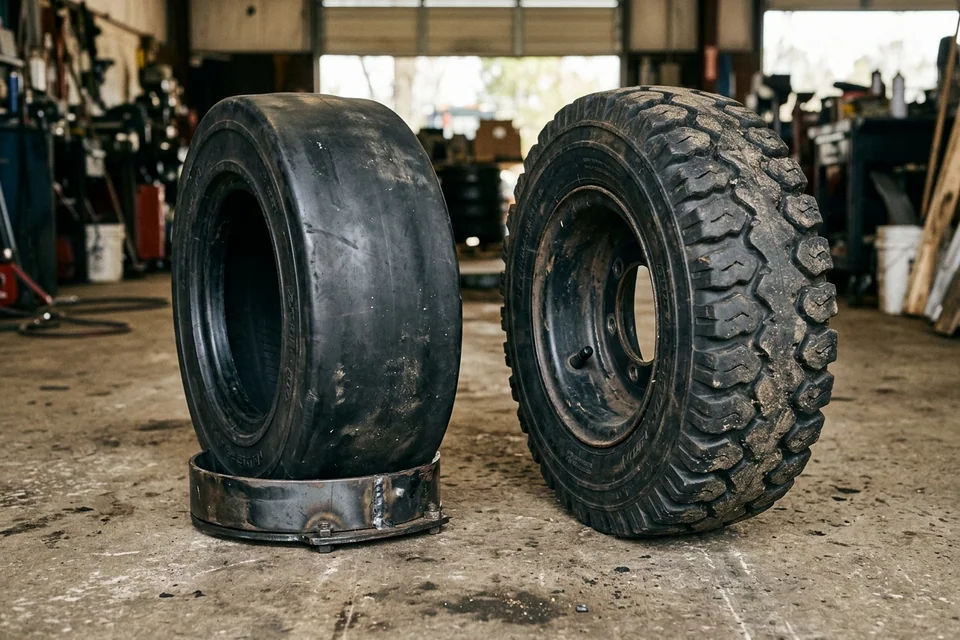
Press-on solid tires are a band of rubber bonded to a steel ring, pressed onto the hub by a hydraulic press pushing many tons. Cushion tires are the same construction, sized for indoor floors. Pneumatic tires sit on a split or lock-ring rim and mount like a small truck tire.
Emergency Mobile Tire Repair runs light-duty units built for road vehicles. Whether we can help with a pneumatic forklift tire depends on size, rim type, and the equipment on the unit that day. Press-on and cushion tires are a press job, and we point you to one.
Before you call
What a Warehouse Manager Should Ask First
Which tire type is on the lift
Press-on, cushion, or pneumatic. The tire face usually says. No bead and no valve stem means press-on.
The size and the count
Forklift sizes read differently, such as 21x7x15 for press-on or 7.00-12 for pneumatic. Read us the tire and say how many need work.
Where the lift can be moved
A lift parked in a clear bay or the yard is workable. One wedged in a rack aisle on a bad tire may not be.
What lifting it takes
A forklift is heavy for its size, with most of the weight over the drive axle. Lifting it safely is part of the yes or no.
In the trade
How Each Type Gets Changed
Press-on solid: the press
The old tire is pushed off the hub and the new one pushed on with a hydraulic press, at a shop or from a truck-mounted press.
Cushion: same press, indoor sizes
Press-on tires sized for smooth concrete and tight aisles. Same tooling, same specialist.
Pneumatic: rim work
The tire comes off a split or lock-ring rim, the new one goes on, and the ring is seated before any air goes in.
Our part
Call with the type, size, and location. For pneumatics we tell you what we can do on site. For press-on, we point you to a press.
Learn more
Repair availability depends on tire condition, damage location, tire size, and safety. If the tire cannot be safely repaired, we help with the next best option.
Step by step
From the Call to the Right Help
- 01
Call with the lift and the tire
Make and model, tire type, the size on the tire, and how many tires need work.
- 02
We sort it by type
Press-on or cushion goes to a press. Pneumatic we check against our equipment and availability.
- 03
You hear yes, no, or who to call
If a light-duty unit can do the pneumatic job safely, you get an honest ETA. If not, we say so and point you to a press.
Decide
Press-On, Cushion, or Pneumatic
| Criteria | Press-on solid | Cushion | Pneumatic |
|---|---|---|---|
| Where it runs | Indoor and smooth outdoor surfaces under heavy loads | Indoor warehouse floors and tight aisles | Yards, lumber, gravel, and rough outdoor ground |
| How it changes | Hydraulic press at a shop or on a specialist service truck | Same press, smaller sizes | Dismount and mount on a split or lock-ring rim |
| A mobile road unit | Not the right tool. We point you to a press | Not the right tool | Possibly, depending on size, rim, and equipment. Ask on the call |
Where it runs
- Press-on solid
- Indoor and smooth outdoor surfaces under heavy loads
- Cushion
- Indoor warehouse floors and tight aisles
- Pneumatic
- Yards, lumber, gravel, and rough outdoor ground
How it changes
- Press-on solid
- Hydraulic press at a shop or on a specialist service truck
- Cushion
- Same press, smaller sizes
- Pneumatic
- Dismount and mount on a split or lock-ring rim
A mobile road unit
- Press-on solid
- Not the right tool. We point you to a press
- Cushion
- Not the right tool
- Pneumatic
- Possibly, depending on size, rim, and equipment. Ask on the call
We explain pricing before any work begins. Quotes are estimates until the technician sees the tire.
Know before you call
Forklift Tire Facts That Decide the Call
Reading the tire
Press-on sizes read as three numbers, outside diameter by width by hub, such as 21x7x15. Pneumatic sizes read like a truck tire, such as 7.00-12 or 28x9-15. The face of the tire usually names the type. If you see a valve stem, it is an air pneumatic.
Lock rings on pneumatic rims
Many pneumatic forklift rims use a lock ring to hold the tire. A ring that is not fully seated before inflation can come off with great force. The trade inflates these in a cage or with a restraint, and that is part of why we check size and rim type before saying yes.
When to replace instead of wait
- Chunking or missing pieces of tread on a solid tire
- Wear down to the wear line molded into most solid tires
- Repeated air loss on a pneumatic that has already been repaired
What we can confirm today, and what to ask on the call
- The site lists cars, SUVs, pickups, work vans, light trucks, and trailers, depending on tire size and availability.
- Forklifts and press-on tires are not named anywhere on the site.
- Call first with the forklift, the tire size, and the tire type. You get an honest yes or no on the phone.
- Pricing is explained before work begins. Quotes are estimates until the technician inspects the tire on site.
- Coverage is Lake, Orange, Osceola, Polk, Seminole, and Sumter counties, from Clermont and Four Corners.
Ask on the call:
- Which commercial vehicles beyond light trucks and trailers
- Press-on tires and the hydraulic press they require
- Pneumatic forklift tires on lock-ring rims
- Who supplies forklift tires, and in which sizes
Forklift questions
Forklift Tire Questions
Do you replace forklift tires?
Press-on and cushion tires: no. Those need a hydraulic press, and we point you to an industrial tire service. Pneumatic forklift tires: possibly, depending on size, rim type, equipment, and technician availability. Call with the type and size.
Can you come to a job site or warehouse?
Yes. We regularly help at workplaces, job sites, lots, and hotels. For a forklift, we need the lift on level ground in a clear spot.
What if I don't know the tire size?
No problem. Send a photo of the tire face and sidewall and we help you read it. A photo of the lift's data plate helps too.
Keep reading
Related Pages
- Commercial tire serviceThe parent page: trucks, RV, forklift, and fleet work.
- Fleet tire maintenancePressure checks, rotations, and roadside response for a working fleet.
- RV tire serviceAge and weight decide most motorhome calls.
- Truck tire repairTrucks that share a yard with the forklift.
- Mounting and balancingHow a tire goes on a rim, where available.
- Check your service areaEnter a ZIP or city to see if we cover you.
Forklift Tire Down in the Yard?
Call Emergency Mobile Tire Repair at (352) 531-6319 with the tire type and size. Pneumatic, we tell you what we can do on site. Press-on, we point you to the right press before anyone rolls.
(352) 531-6319