
Highway Flat Tire Assistance
Flat Tire on the Highway? Get Safe First
Signal, ease off the gas, and work your way to the right shoulder or the next exit. Once you are off the road with hazards on, call Emergency Mobile Tire Repair. Tell us the road, direction, and mile marker. We tell you whether a technician can work there.
- I-4, US-27, and the Turnpike are the roads this page is about
- A wide, paved shoulder well clear of the lanes makes mobile service possible
- Narrow shoulder, bridge, or curve? We say when a tow is safer
Getting off the road
How to Reach a Safe Spot
A tire going down at highway speed pulls the car to one side. Hold the wheel, ease off the gas, and let the car slow before you brake. Signal and move right one lane at a time. A ruined tire matters less than a collision.
If the shoulder is wide and paved, pull as far right as it allows and stop. If it is narrow, or you are on a bridge or a curve, keep rolling slowly to the next exit. The tire may be finished either way. You come first.
Stopped? Hazards on. Stay belted in if traffic is close. Then call with the road, the direction, and the nearest exit or mile marker. Tell us how much room is beside the car. That detail decides mobile service or tow.
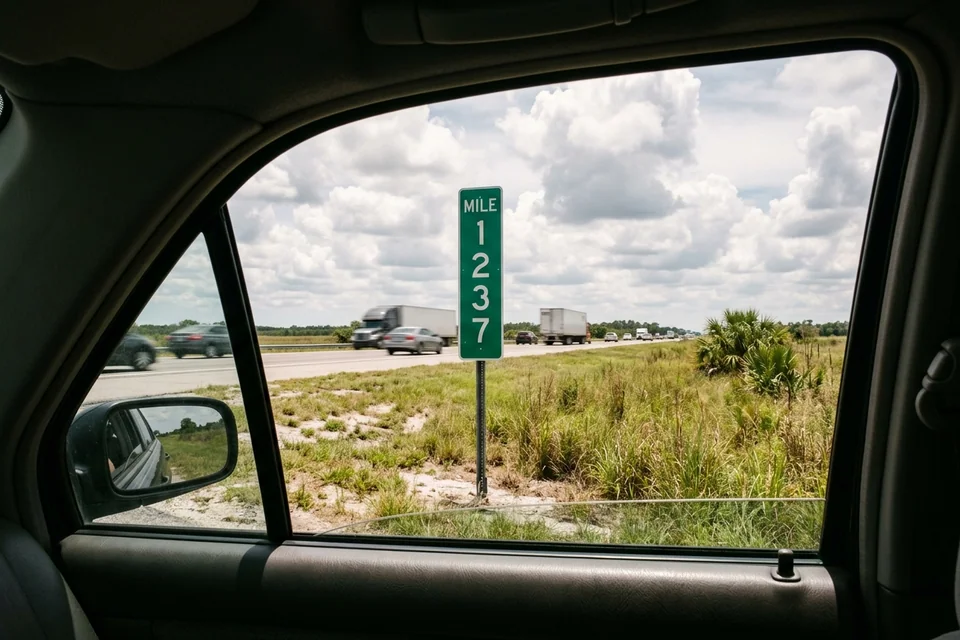
The spot
A Workable Shoulder Looks Like This
We look at the spot before the tire. These decide it.
Room on the traffic side
The technician kneels at the wheel. If that wheel faces the lanes, the shoulder must be wide enough to stay out of traffic.
A clear line of sight
Drivers need to see you in time to move over. A straight, flat stretch works. A hill crest or the inside of a curve does not.
Firm, level ground
A jack needs solid pavement. A soft grass shoulder or a steep slope rules out lifting the car.
Daylight or good lighting
Night work on an unlit shoulder is harder for everyone. Tell us if it is dark.
Your options on the shoulder
Repair, Spare, Replacement, or Tow
Which one fits depends on the tire and the room beside the car.
Repair on the shoulder
A tread puncture within repair limits can be plugged and patched where the car sits, when the spot allows.
Learn moreSpare install
Your spare goes on and gets inflated. We check it first. Spares sit flat in trunks for years.
Learn moreReplacement where available
A shredded tire with no spare needs a replacement. Depending on size and availability, we fit it at the car.
Learn moreTow to a shop
No workable shoulder means a tow. We say so on the call rather than put anyone in a live lane.
Repair availability depends on tire condition, damage location, tire size, and safety. If the tire cannot be safely repaired, we help with the next best option.
Step by step
From the Lane to the Shoulder to Moving Again
- 01
Get right and off
Signal, slow gradually, and reach the right shoulder or an exit. Do not stop in a lane.
- 02
Call with road and direction
Road, direction of travel, exit or mile marker, and shoulder width.
- 03
Hear mobile or tow
If the spot is safe, an honest ETA. If not, we help you get a tow.
- 04
Work, then merge carefully
The technician works from the safe side. Build speed on the shoulder, then merge in a gap. On a spare, mind its speed limit.
Decide
Mobile Service on the Shoulder or a Tow?
The shoulder decides, not the tire.
| Criteria | Mobile service on the shoulder | Roll to the next exit first | Tow to a shop |
|---|---|---|---|
| Choose this when | Wide paved shoulder, straight road, car well clear of the lanes | Narrow shoulder here, but an exit or wider stretch is close | No shoulder, a bridge or curve, a bent wheel, or heavy traffic right beside you |
| What it costs you later | The job itself, done at the car | Possibly a tire that was repairable before you rolled on it | The tow, the shop visit, and the time without the car |
| Passing traffic | Hazards on. Florida expects drivers to move over a lane, or slow down when they cannot. Do not count on it | Hazards on while rolling, well below the speed of traffic | Hazards on until the tow arrives |
Choose this when
- Mobile service on the shoulder
- Wide paved shoulder, straight road, car well clear of the lanes
- Roll to the next exit first
- Narrow shoulder here, but an exit or wider stretch is close
- Tow to a shop
- No shoulder, a bridge or curve, a bent wheel, or heavy traffic right beside you
What it costs you later
- Mobile service on the shoulder
- The job itself, done at the car
- Roll to the next exit first
- Possibly a tire that was repairable before you rolled on it
- Tow to a shop
- The tow, the shop visit, and the time without the car
Passing traffic
- Mobile service on the shoulder
- Hazards on. Florida expects drivers to move over a lane, or slow down when they cannot. Do not count on it
- Roll to the next exit first
- Hazards on while rolling, well below the speed of traffic
- Tow to a shop
- Hazards on until the tow arrives
We explain pricing before any work begins. Quotes are estimates until the technician sees the tire.
Know before you call
Highway Facts That Change the Plan
What Florida expects of passing drivers
Florida's Move Over law expects passing drivers to move over a lane for a stopped vehicle with flashing lights. If they cannot, they are expected to slow well down. That helps. It does not protect you. Stay belted in when traffic is close.
How the job differs on a highway
- The car is worked on from the side away from traffic, hazards on the whole time
- A wheel on the traffic side is touched only with enough shoulder to stay out of the lane
- Pressure is checked before you merge, because you will be back at speed within a minute
- A replacement where available takes longer. On a marginal shoulder we may suggest the spare now and a replacement at a safer spot
When a tow is the safer call
- No shoulder, or one too narrow to kneel on the traffic side
- A bridge, overpass, curve, or hill crest where drivers cannot see you
- A bent wheel the spare will not seat on
- Heavy rain or darkness on an unlit stretch
Highway questions
Highway Flat Tire Questions
Can you come to I-4, US-27, or the Turnpike?
Yes, when the shoulder is safe to work on. Tell us the road, direction, and mile marker. If a tow is safer, we say so.
How fast can you arrive?
Response times vary by location, traffic, and technician availability. We give you an honest ETA before dispatching.
Should I drive on a flat tire?
Not if you can stop safely. On a narrow shoulder, rolling slowly to the next exit can be the safer choice.
Can you help if I don't have a spare?
Often yes. Send a photo of the sidewall on one of the other tires. Repair or a replacement may be possible, depending on availability and the spot.
Keep reading
Related Pages
- Roadside tire assistanceThe silo top: what to tell dispatch.
- Locking lug nut removalMissing key, dealer codes, removal.
- Stripped lug nut removalRounded nuts and the stud underneath.
- Spare tire installationIs the spare usable, and how far.
- Blowout assistanceKeeping control at speed.
- US-27 corridorThe towns we reach along US-27.
- Check your service areaEnter a ZIP or city.
On a Highway Shoulder Right Now?
Stay belted in with hazards on and call Emergency Mobile Tire Repair at (352) 531-6319. Tell us the road, your direction, and the mile marker. We tell you honestly whether mobile service or a tow is the safer next step.
(352) 531-6319